

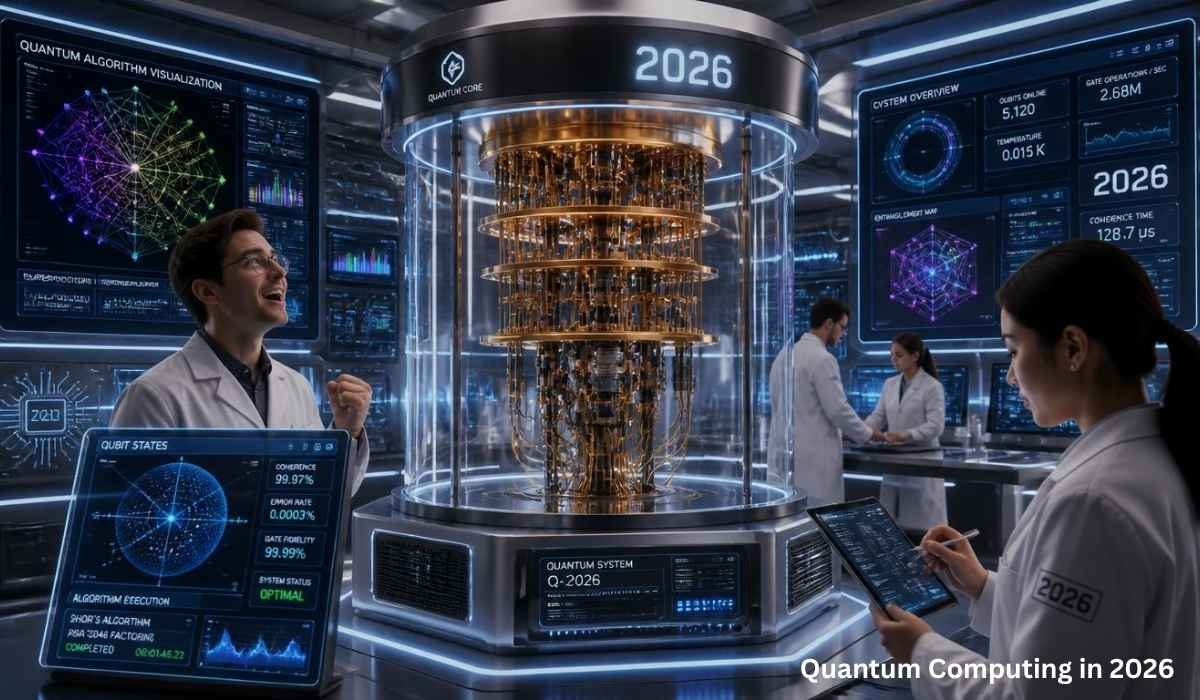
Quantum computing stopped being a lab curiosity a while back, but 2026 is the year it started feeling like an industry instead of an experiment. Chips are getting more stable, algorithms are producing results that classical machines genuinely can’t check, and money is pouring into the sector at a pace that suggests investors think this is real. At the same time, the hard problems – noise, decoherence, and the sheer engineering cost of scaling – haven’t gone anywhere.
This piece walks through where the technology stands right now, the milestones that got us here, and the gap that still separates today’s machines from the fault-tolerant systems everyone is chasing.
Where the Real Bottlenecks Still Sit
Before getting into the wins, it’s worth being honest about why quantum computing is still hard.
- Qubit fragility: superconducting qubits operate near absolute zero and lose their state in microseconds if anything disturbs them.
- Error accumulation: even tiny disturbances from control electronics or stray heat can corrupt a calculation before it finishes.
- Verification difficulty: once a quantum system grows large enough to be useful, it also grows too large for a classical computer to double-check the answer.
- Talent and cost: building and operating a quantum processor requires physicists, cryogenics engineers, and software specialists working together, which keeps the field expensive and slow to staff.
These aren’t solved problems. They’re the reason progress in this space is measured in careful, incremental steps rather than sudden leaps – even when a single result, like the ones below, changes the trajectory of the whole industry.
The Error-Correction Turning Point
The single most important shift in recent years has been the move away from “more qubits equals more noise.” For most of quantum computing’s history, adding qubits made systems less reliable, not more.
That changed with Google’s Willow chip, which demonstrated below-threshold quantum error correction – arranging physical qubits into larger grids and watching the logical qubit error rate go down, not up, as the grid expanded. It was proof that a fault-tolerant quantum computer isn’t just theoretically possible; it’s an engineering target with a visible path.
Since then, the pace of error-correction research has accelerated sharply, with peer-reviewed output on the topic climbing well past what the field was producing just two years earlier. NVIDIA has since released open neural-network-based decoder architectures aimed at suppressing error rates in quantum color codes by large multiples, and several hardware teams are now treating error correction as a shared, collaborative problem rather than a proprietary one.
Read Also: The Complete Guide to Image Search Techniques in 2026 (And How to Actually Use Them)
Topological Qubits Move From Theory to Hardware
A second, quieter revolution has been happening around topological qubits – a qubit design that stores information in the global structure of a system rather than a single fragile point, making it naturally resistant to local noise.
Microsoft’s Majorana 1 processor was built specifically around this idea, with a design intended to scale toward a million qubits on a single chip. Separately, Quantinuum and academic partners demonstrated a universal topological gate set using non-Abelian anyons on a trapped-ion system, combining braiding and fusion operations to build fault-tolerant logic gates directly into the hardware.
If topological approaches keep maturing, they could let future systems reach logical qubits using far fewer physical qubits than today’s surface-code methods – which would make large machines meaningfully cheaper and faster to build.
Verifiable Quantum Advantage Finally Arrives

For years, “quantum advantage” claims came with an asterisk: the results were fast, but nobody outside the lab could confirm they were genuine rather than an artifact of how the benchmark was designed.
That changed with Google’s Quantum Echoes algorithm, which produced results roughly 13,000 times faster than the best classical supercomputers and could be independently verified. This is arguably more significant than raw speed – it means quantum hardware can now be trusted to reveal real structural information about physical systems, from molecules to magnetic materials, not just win a synthetic race against a classical machine.
Practical Applications Are Starting to Show Up
Better hardware only matters if it solves something. A handful of hybrid quantum-classical projects have moved past pure demonstration:
- Drug discovery and chemistry – quantum-assisted simulations are being used to model how molecules bind and how solvent environments behave inside proteins, detail that’s extremely costly to capture with classical methods alone.
- Materials and energy – teams are using quantum processors to study catalysts, battery chemistry, and plasma behavior relevant to fusion research.
- Finance and logistics – portfolio optimization and routing problems are being tested on quantum hardware, though most of this work still runs on simulators rather than physical qubits.
- Medical devices – IonQ and Ansys reported a quantum-assisted simulation that outperformed a classical high-performance computing setup on a real medical device model, one of the first documented cases of measurable quantum advantage in an applied, non-benchmark setting.
- Quantum networking – a three-node quantum network was tested across existing fiber-optic infrastructure, a step toward distributed quantum computing and eventually a broader quantum internet.
None of this replaces classical computing. The pattern across every case is the same: quantum hardware handles a narrow, well-chosen sub-problem while classical systems do the rest.
Cryptography Is Quietly Becoming Urgent
A large, fault-tolerant quantum computer could theoretically break the public-key encryption that protects most of today’s internet traffic using Shor’s algorithm. No machine capable of that exists yet, but organizations are increasingly acting as though the clock is already running – because data encrypted today can be stored and decrypted later, once the hardware catches up.
That’s driving real movement toward post-quantum cryptography (PQC), new encryption standards designed to resist quantum attacks. Even outside traditional tech, this urgency has spread – for example, Bitcoin infrastructure groups have launched dedicated initiatives to prepare blockchain networks for a quantum-safe future, treating cryptographic migration as a near-term engineering task rather than a distant hypothetical.
Read Also: Gramhir.Pro AI Image Generator: An Honest 2026 Review After 1,000+ Test Generations
Investment and Infrastructure Keep Expanding

The commercial side of quantum computing has shifted from research funding to something closer to a normal tech sector. Multiple companies have scaled processors well past where they stood just a couple of years ago, cloud-based quantum-computing-as-a-service platforms have expanded across major providers, and national governments have committed long-term funding to domestic quantum programs.
Market estimates vary widely, but most forecasts agree on the direction: steady, compounding growth as pilot projects mature into deployed tools, even though direct revenue from quantum computing itself remains a small fraction of the broader tech economy today.
What to Watch For Next
Putting it all together, quantum computing in 2026 sits at a specific, identifiable stage:
- Hardware has moved past pure demonstration and into verifiable quantum advantage on select problems.
- Error correction and topological qubit research have replaced raw qubit-count headlines as the industry’s main scoreboard.
- Early commercial quantum applications exist in chemistry, materials, medical simulation, and networking – narrow, but real.
- Quantum-safe cryptography has gone from an academic talking point to an active migration effort.
The honest summary: this isn’t a technology that arrived overnight, and it still won’t. But the gap between “interesting physics experiment” and “tool that solves problems classical computers can’t” is visibly closing, one verified result at a time.
Final Thoughts
Quantum computing in 2026 no longer needs hype to sound impressive – the results speak for themselves. Error correction that actually reduces noise, topological qubits moving from theory to real hardware, and independently verifiable quantum advantage mark a field that has crossed from promise into proof.
Businesses aren’t just watching anymore; they’re piloting real applications in chemistry, medicine, and cryptography. The technology is still young, expensive, and narrow in what it can solve, but the trajectory is unmistakable. What used to be a distant, decades-away idea now looks like infrastructure quietly being built in real time.
Frequently Asked Questions
Is quantum computing actually useful yet, or still just research?
Both, depending on the task. Most work still runs through cloud access and research partnerships, but a growing number of narrow, well-defined problems – molecular simulation, certain medical device models, specific optimization tasks – are already showing measurable advantage over classical methods.
What changed the most recently?
The shift from raw qubit counts to verified results. Error-corrected logical qubits and independently checkable quantum advantage claims are now the benchmarks that matter, rather than how many physical qubits a chip has.
Should businesses worry about encryption right now?
Not because of an imminent break, but because data intercepted and stored today could be decrypted once fault-tolerant machines exist. That’s why post-quantum cryptography adoption is accelerating well ahead of the hardware that would actually threaten current encryption.
Which industries are closest to real quantum benefit?
Chemistry, materials science, and specific optimization or simulation problems in finance and logistics are furthest along, mainly because they can be broken into the kind of narrow sub-problems quantum hardware is currently good at.
